

Korean farm machinery reaches Ghana, Africa (reported by Kyunghyang Shinmun)
Interview: Kim Chung-hoe, Director of the KOPIA Ghana Center, who passes on Korean rice-growing technology to Africa
By Yoon Hee-il, Senior Reporter · Accra · 2023.11.30
"I want to build the technical foundation so that people in Africa can eat rice to their fill. Freeing the many people suffering from hunger from that pain is the final dream of my life." This is how Director Kim Chung-hoe (76), whom we met on Nov. 22 at the KOPIA (Korea Partnership for Innovation of Agriculture) Ghana Center in Accra, described his dream.
KOPIA is the "Overseas Agricultural Technology Development Project" run by the Rural Development Administration. KOPIA centers are currently established in 23 developing countries across Africa, Southeast Asia and Latin America. Director Kim, who arrived here in September 2020, is devoting himself to passing Korea's excellent rice-growing technology on to the people of Ghana, judging that Ghana can become fully self-sufficient in rice, its staple food, if only its rice-growing technology is improved.
"Ghana's annual rice demand is 1.92 million tons, but its own production is only 970,000 tons. It can grow rice twice a year, but productivity is low because of poor farming technology. On an area basis the current yield is only 2.9 tons per hectare; if we raise it above 5 tons, Ghana could escape its chronic rice shortage."
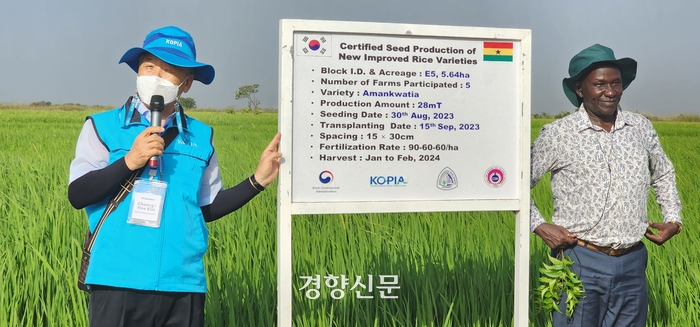
Based on "Tongil" rice, which once made Korea self-sufficient in food, the center has bred a new variety suited to Ghana, named "KoreaMo." Its average yield of about 7 tons per hectare is far more than double that of local traditional varieties. The KOPIA Ghana Center plans to produce 300 tons of quality seed on 60 hectares this year, distribute it to Ghanaian farmers, and gradually expand the area.
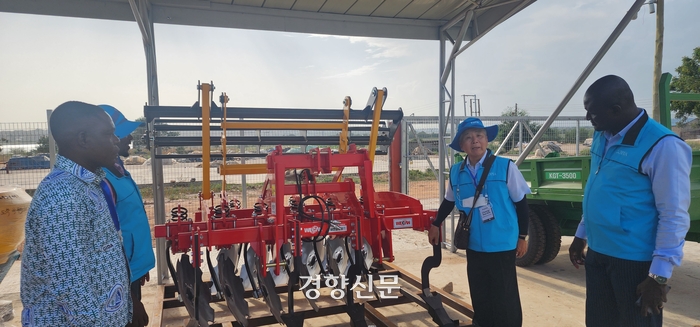
"By 2027 we aim to produce 5,700 tons of quality seed on 900 hectares and distribute it to farmers, enabling rice cultivation on 114,000 hectares. If our rice is grown on more than a third of Ghana's total rice area (300,000 hectares), it will greatly help solve the country's rice shortage." In the Dawhenya area, the Korea Rural Community Corporation is carrying out land-consolidation and irrigation works, and KIAT is installing a solar power plant — part of the government's "K-Rice Belt" project to supply high-yield rice seed and transfer farming technology to eight African countries.
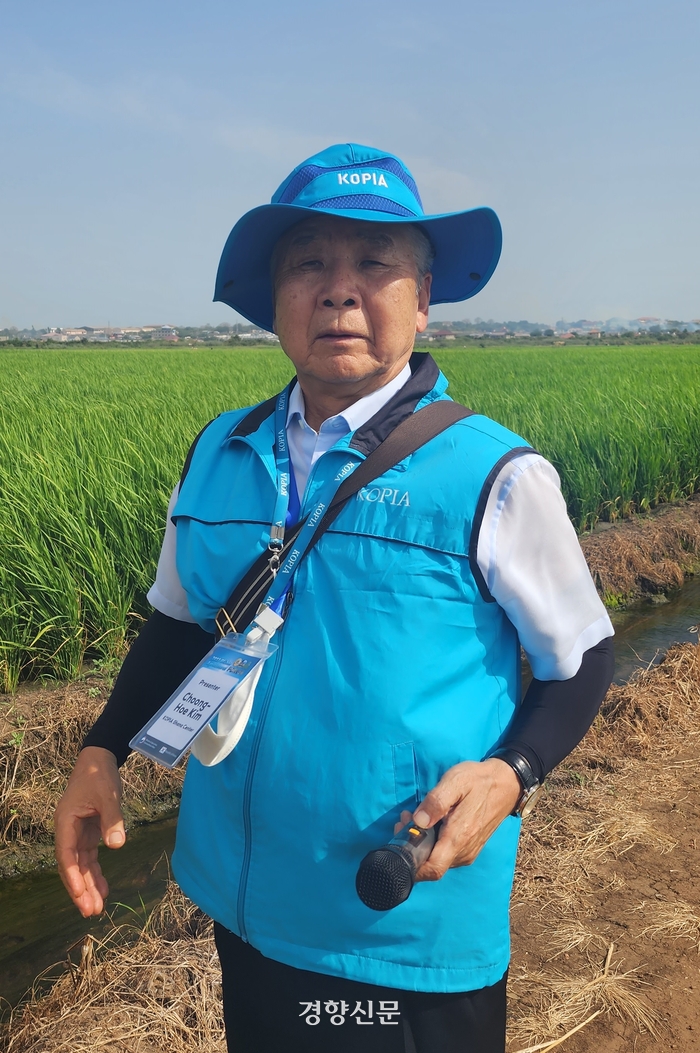
Director Kim — a doctor and scholar of plant medicine who graduated from Seoul National University's College of Agriculture and studied world-class agricultural technology in Denmark, the United States and Japan — also devotes himself to raising the level of Ghana's tomato and poultry farming. After retiring from the Rural Development Administration, he transferred agricultural technology in Kenya from July 2013 to 2018, where he distributed new potato varieties and advanced cultivation methods that nearly tripled yields from 3.2 to 9.2 tons per hectare and taught poultry techniques that raised incomes ninefold — earning the nickname "Father of African Agriculture." Last November he received the Prime Minister's Award at the Korea Overseas Volunteer Awards.